Processing quartzite requires reliable technologies and integrated workflows capable of handling a material that combines exceptional hardness, structural variability, and outstanding aesthetic value.
From block cutting to final polishing, every stage affects slab quality, raw material yield, and production continuity. For this reason, Pedrini develops complete plants and customized solutions integrating cutting, handling, resin treatment, automation, and finishing processes.
Processing quartzite: a complex, high-value material
Quartzite is a metamorphic rock valued for its strength, hardness, and the distinctive visual appeal of its veining. These same qualities that make it highly prized also make it one of the most challenging materials to process in the natural stone industry.
The main challenges include:
High mechanical strength and abrasiveness, which place significant stress on tools;
The presence of potential microfractures or internal stresses;
Variations in hardness within the same block;
The sensitivity of slabs during handling;
The need to preserve colour, veining, and visual depth.
Achieving uniform slabs and high-quality surfaces therefore requires precise control of process parameters. It is not enough for each machine to perform well individually: cutting, handling, reinforcement, and polishing must operate as parts of a single integrated system.
Every quartzite requires a specific approach. Discover how Pedrini technologies can transform the complexities of this material into quality, yield, and production efficiency.
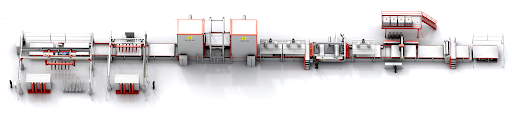
The journey from a raw block to a finished slab involves four key stages: cutting, handling, resin treatment, and polishing. Added to these is automation, which connects the different processes and makes the workflow more continuous, safe, and controllable.
Block cutting: precision and yield with the Multiwire Jupiter GS240
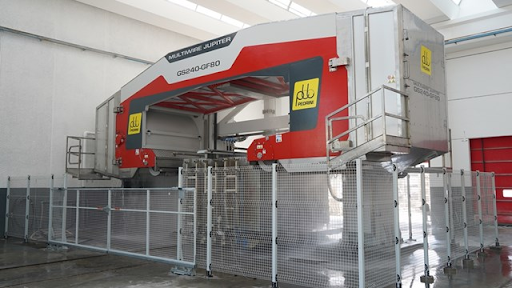
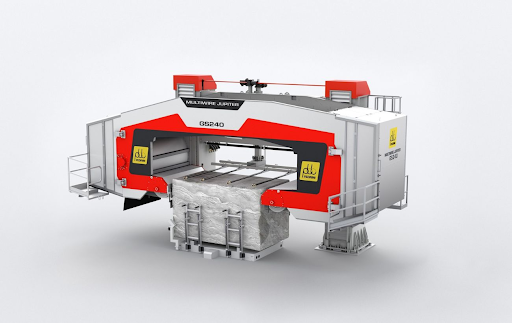
Block cutting determines how many slabs can be obtained from a block and directly affects the surface regularity required for subsequent processing stages. The Multiwire Jupiter GS240 is specifically designed to cut quartzite, marble, and granite with high precision, even when dealing with areas of varying hardness that could otherwise cause wire deviation.
A key factor is the diameter of the diamond wire: for the same block size and final slab thickness, a thinner wire allows more slabs to be produced while reducing the amount of material converted into waste. The GS240 uses diamond wires with diameters starting from 4.3 mm. With this configuration, it can achieve yields of up to 39.2 m²/m³ when producing 2 cm-thick slabs.
The benefits impact both productivity and process sustainability:
More slabs obtained from each block;
Lower generation of waste sludge;
More than 15% reduction in electricity consumption (kWh/m²);
Better utilization of a valuable natural raw material.
The machine's 2.3-meter flywheel ensures smooth and uniform wire movement, while Pedrini’s tensioning, guiding, and washing systems contribute to cutting accuracy and continuous operation.
Slab handling: automation with Butterfly B416 and Mantis B419
After cutting, slabs must be transferred between the various processing stages without compromising the integrity of the material. With quartzite, where microfractures and structural discontinuities can increase the risk of breakage, handling operations require precise, repeatable, and carefully controlled movements.
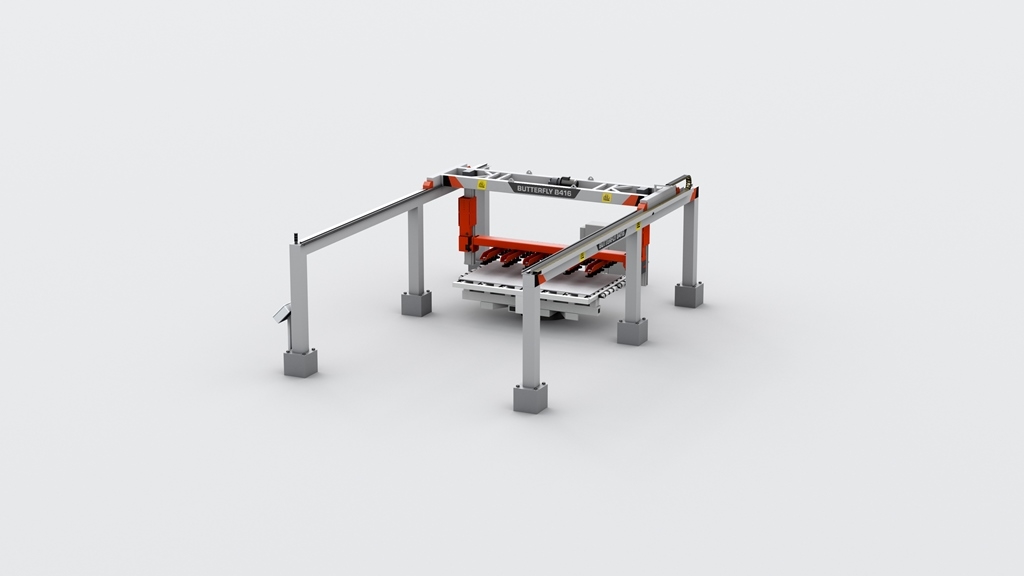
The Butterfly B416 is an automatic slab loading and unloading system that travels on overhead rails. This configuration frees up floor space and enables a more efficient plant layout, while also supporting book-match applications.
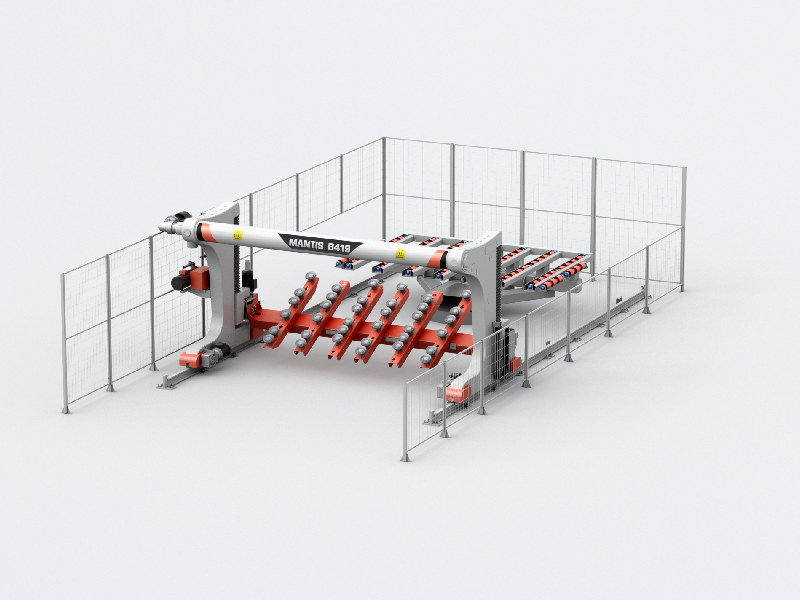
The Mantis B419, on the other hand, operates with floor-level travel. Its two-part mobile structure supports a 360° rotating suction cups unit and can handle slabs up to 3,600 × 2,200 mm. Movement programming is managed through a control panel equipped with a colour monitor.
The choice between the two solutions depends on the production flow, the available space, and the level of automation required. In both cases, the objective is to reduce manual handling, protect the material, and continuously feed the downstream machines.
Advanced resining: consolidating and enhancing quartzite
Resining consolidates the slab structure, reduces the risk of breakage, and enhances the colour depth and veining of the material. It is therefore a key stage in quartzite processing, especially when the stone presents porosity, cracks, or natural discontinuities.
Resinline is the Pedrini line for the treatment and restoration of marble, granite, quartzite, and other natural stone slabs and strips. The process is divided into five stages:
material loading;
drying and preheating;
epoxy resin application;
catalysis and curing;
unloading.
Its modularity allows the line to be customized according to the material, the resin used, the required productivity, the level of automation, and the available space, with configurations ranging from 6 to 60 cycles per hour.
At the centre of the process, V-WAVE can be integrated, the Pedrini oven that combines microwave technology and a Vacuum system. Air extraction and the initial reduction in viscosity promote deep and uniform resin penetration. Catalysis is activated within a few minutes, even deep inside the material, and is then completed in the dedicated curing tower
This technology offers concrete advantages:
reduced catalysis times compared to traditional systems;
fast and deep treatment;
lower energy consumption;
the possibility of using any type of epoxy resin;
simplification of the retouching phase;
reduction of holding space between processes;
operational safety thanks to the closed-door cycle.
Microwave and Vacuum technologies are thus integrated into the heart of the resining process to increase efficiency, quality, and production flexibility.
Polishing and finishing: Galaxy B220GX and B220GX-T3
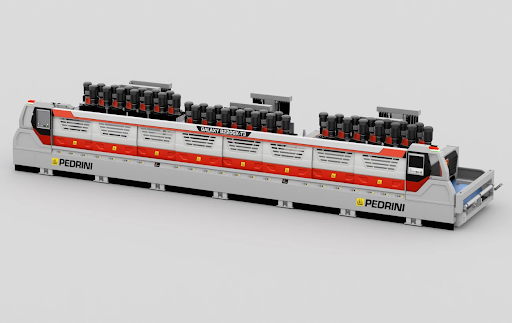
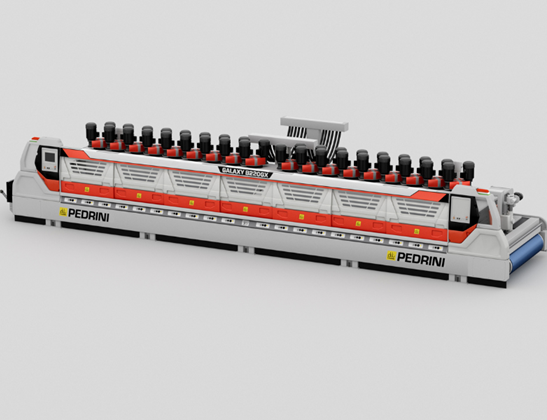
Polishing gives quartzite its final aesthetic finish, bringing out the colour, veining, and depth of the surface. Pedrini Galaxy B220GX lines are available in configurations ranging from 12 to 22 heads and can perform both mirror polishing and honing.
The slab profile is detected by 64 optical sensors, while an ultrasonic reader measures the thickness. This data regulates the vertical stroke of the spindles and supports abrasive wear monitoring.
The machine's technological core includes:
the patented Rotor spindles, featuring electronic positioning and pneumatic counterpressure;
the patented Antishock head, equipped with seven oscillating abrasive-holder levers;
the Aquila head, which can be installed in the first positions when pre-honing is required.
For different productivity and configuration requirements, the Galaxy B220GX-T3 features a three-beam structure while maintaining the focus on consistent finishing quality.
The advantages of automation and plant integration
In quartzite processing, efficiency does not depend solely on the performance of individual machines. The real advantage comes from the ability to integrate all stages into a coherent workflow, where each process receives and transfers the material under the expected conditions.
Automation makes it possible to:
reduce operational variables and manual interventions;
minimize the risk of damage during material handling;
ensure more consistent process times and operating parameters;
improve safety, traceability, and production continuity;
adapt the slab route according to the characteristics of the material and the desired final result.
Designing the plant as an integrated system also makes it possible to optimize available space and prevent bottlenecks between cutting, resining, and finishing operations.
The Pedrini approach: experience, customization and support
Since 1962, Pedrini has been designing and manufacturing plants and machines for natural stone processing. The experience gained both in the field and within its Research & Development centre translates into solutions tailored to the real needs of each production facility.
For quartzite processing, this means starting from the material itself, production volumes, quality objectives, and the available plant layout to define the most suitable configuration. The relationship does not end with delivery: after-sales service, both on-site and remote, supports customers in maintaining reliability and efficiency over time.
The opportunity to test solutions, engage directly with the technical team, and collaborate with qualified partners further strengthens an approach based on specialization, customer focus, and responsibility for achieving results.
Case History: Pedrini supports the growth of HBB Madencilik in Afyon
A concrete example is the project developed with HBB Madencilik in Afyonkarahisar, Turkey. Following the technical and commercial success achieved with an initial Jupiter GS230 Multiwire, the company chose Pedrini once again for its new production facility, built on approximately 22,000 m² of covered area along the main road between Ankara and Afyon..
The two companies worked closely together to design the plant layout and refine machine positioning in order to optimize material flow throughout the facility. The project includes:
a Multiwire Jupiter equipped with 108 diamond wires, capable of cutting marble, granite, quartzite, and exotic stones into thin slabs with thicknesses down to 12 mm;
a Multiwire Jupiter equipped with 72 diamond wires for the production of slabs in various thicknesses;
a marble polishing line featuring a Butterfly B416, two Galaxy B220MX polishing machines with 10 and 18 heads, a UV oven, waxing machine, and anti-scratch system;
a Galaxy B220GX-20 line dedicated to granite and quartzite processing, including a Butterfly B416 and a 20-head polishing machine;
a Cutline cutting line for producing formats up to 1,200 × 1,200 mm.
The integration of these technologies enables HBB to expand the range of processed materials, increase production capacity, and efficiently handle even fragile or delicate stones. The project demonstrates the value of a partnership that combines plant layout design, dedicated technologies, and specialized technical support.
Do you want to optimize your quartzite processing?
Every quartzite, plant, and production goal requires a specific solution. Pedrini technologies for cutting, handling, resin treatment, and polishing can be integrated into a plant designed around your needs..
Contact the Pedrini team to analyse your production process and identify the most suitable configuration.